July 10, 2026
Hello, everyone,
A council meeting was held this Tuesday—these were the items on the agenda—all of which were approved. I’ll go into more detail about some of them below. I’ll continue with further details in next week’s newsletter.
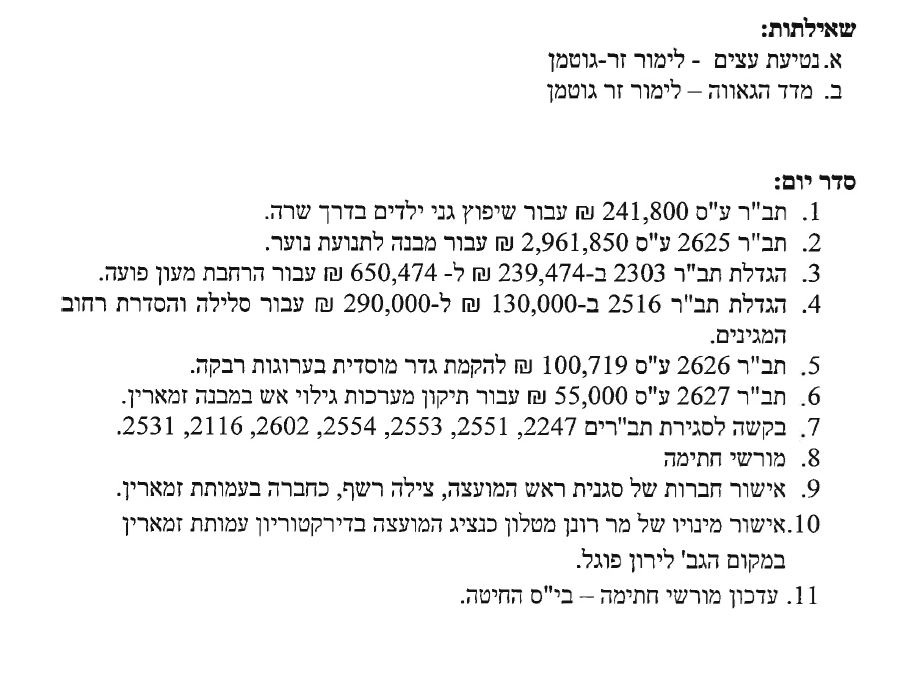
First topic: The council chair’s response to the second inquiry I submitted, and how many trees were actually planted in the community in 2024 and 2025
How many trees were planted by the local council and funded by the local council in public spaces—including sidewalks, walking paths, public parks, educational institutions, and more—in 2024 and 2025? (Please provide numerical data for each respective year.) One of the solutions to the climate crisis and heat mitigation is planting trees and preserving existing ones—these are essential. In particular, trees along walking paths encourage walking in public spaces. When I served as chair of the Environmental Quality Committee, I tried to advance this issue. So I asked the question, and the answer revealed something I hadn’t expected—the council head provided incorrect data in his official response (which I’m already used to after countless lies), but the actual figures are better than what he disclosed. In fact, more trees were planted.
- The council head’s response revealed a very grim reality regarding the provision of incorrect and outdated information presented as an official response. This isn’t the first time I’ve been given incorrect information. Why??
- The council chairman’s incorrect response points to a problem with the council’s management—no one on the council knows how many trees are planted each year. Because apparently, the council chairman doesn’t really care.
- The council head’s response indicates a lack of transparency, because if there were transparency, the council head would know the exact number and wouldn’t have provided an incorrect figure. This information should be accessible in the council’s database, since every project has a landscaping plan that specifies the quantity, location, and type of trees.
This is the response the council head provided—
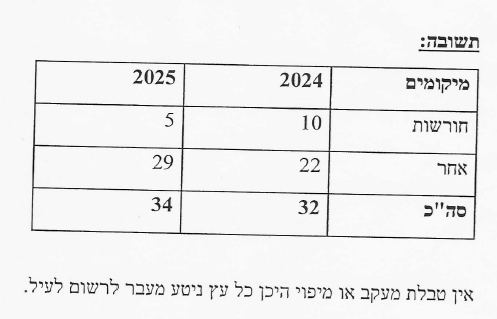
And this is the table of facts based on data compiled by the Tree Guardians. Volunteers from among the Tree Guardians conducted a brief review of the issue regarding major projects, and the following data pertains to the years 2024–2025, based on projects that were budgeted and carried out from 2023 through 2025 -
|
Location |
No. of Trees |
Notes |
|---|---|---|
|
Garden at the entrance near Ma’ayan Tzvi |
27 |
|
|
Landscaping along HaKovshim Street |
Approx. 65 |
|
|
Nili Parking Lot |
8 |
More trees must be added to heat-emitting surfaces |
|
Marvad HaKsamim Street |
Approx. 10 |
|
|
Moradot HaBeer Neighborhood, Plan Sh/619 |
Approx. 100 |
|
|
Aharon Promenade and adjacent public open space |
Approx. 120 |
|
|
Area around Tzofei Square on Rabin Road |
Approx. 10 trees |
|
|
Wine Park |
Hundreds of trees |
Carried out by the Israel Land Authority |
Second Topic: The Mayor’s Response to the Second Interpellation I Submitted
First inquiry I submitted on the occasion of Pride Month—“The 2025 Pride Index was recently published. The index reflects municipal activities for members of the LGBTQ+ community in the locality across various parameters. The various responses provided, etc. In the 2025 index, neighboring municipalities such as Hof HaCarmel and the Binyamina-Givat Ada Regional Council ranked highly on the Pride Index. Zichron Ya’akov is not mentioned at all as having been surveyed for this index.
Was the local council asked by the editors of the Pride Index to participate in this survey, and if so, what was the response to the questionnaire that was sent?”
The mayor’s response was brief and, it must be said, quite disappointing: “The council is not aware of any request on this matter.”
My position: There is no reason why Zichron Ya’akov should not take the initiative to participate in this index next year. The council has an LGBTQ coordinator, and there are events and activities for the community. If the index’s editors are not familiar with the professional staff member at the council responsible for these activities, I expect the mayor or the director of the relevant department to ensure that such contact is established in the future. I don’t know what else is missing for us to be included in the ranking—and to rank highly.
Third issue: Renovation of kindergartens belonging to the Center for Torah Education Association
The kindergartens on Derech Sarah underwent an allocation process several years ago and are operated by the Center for Torah Education (Malt), headed by CEO Rafi Manat, who is considered a leader of the ultra-Orthodox community in Zichron Ya’akov. These kindergartens, which were previously owned by the local council, were allocated to this association in 2019 after undergoing renovations.
The council head claims that there has been ground subsidence and, in addition, years of neglect on the part of the association—the kindergartens are in a deplorable condition. An inspection by the Ministry of Education determined that the kindergartens will not open on September 1 unless all deficiencies are corrected.
Since the buildings were allocated to the nonprofit organization, it is responsible for their ongoing maintenance. It is heartbreaking to see the state of neglect in which the children find themselves.
The council head reported that the Ministry of the Interior has authorized the council to repair only the defects related to ground shifting at the site, and an assessment was conducted by an engineer on behalf of the council, which confirmed the ground shifting. According to the council head, this repair is the responsibility of the council, which allocated the buildings. The association is obligated to repair all other serious defects, and they have committed to doing so. (We were provided with a bill of quantities that does not fully correspond to the ground movement repairs, and it remains to be reviewed.)
I voted in favor of the budget allocation out of concern for the children, based solely on the council chairman’s assertion that approval had been granted by the district director at the Ministry of the Interior, and on his statement that an engineer’s opinion had been provided confirming that such ground shifts had indeed occurred. —the approvals the council chairman referred to were not presented to us during the meeting. The council chairman claimed that such approvals exist and that he would email them to us the following day—we have not received the relevant documents to date. I will continue to provide updates.
Fourth issue: Construction of the youth center to be allocated to the Maccabi Tza’ir movement
Important news—Zichron Ya’akov has received budgetary authorization from the Ministry of Education in the amount of 1.9 million NIS for the construction of a youth center with a total area of 325 square meters. The council has committed to investing an equal amount from its own budget. And in a highly unusual legal move—the Maccabi Youth Movement has committed to allocating an additional 1 million NIS toward the building under the conditions detailed in its letter. A total of 5 million NIS will be invested in the youth center, which is expected to cover 500 square meters. This was promised by the council head, as the Maccabi Youth Movement is the largest in the town, with 1,000 active members and alumni.
Background: During Ziv Deshe’s previous term, a plot of land was identified near the Moshava High School and Moshava Park as part of the community’s educational complex—a site for constructing a youth movement center that would serve at least 1,000 alumni and members. In 2022–2023, the council approved a budget/special fund allocation of 500,000 NIS for the building’s design and obtaining permits. However, in 2024, the current council chair requested to cancel this budget/special fund allocation and reallocate it to other needs. Had it not been for this move by the current council head, we would already have had complete plans and building permits!!! And only now are they addressing this, which is delaying construction.
Legally speaking, the budget allocated by the Ministry of Education is for the construction of a youth center. It is not possible to determine which organization will receive it until a transparent and equitable allocation process is carried out. During the previous term, when the plenary session was asked to approve the planning budget, this point was even emphasized by the council chair and the legal advisor. At the last meeting, the council’s legal advisor clarified these legal points: He explained that Maccabi Tza’ir’s participation in the construction can only be approved after the allocation process for the youth movement is completed—assuming that is the outcome of the allocation process. I intend to monitor the process to ensure it is conducted in accordance with the law. The largest youth movement in Zichron Ya’akov, which carries out wonderful activities, deserves a building free of any legal issues.